In the fast-paced industrial sectors of the UAE—from sprawling construction sites in Dubai to heavy machinery workshops in Abu Dhabi and Sharjah—hydraulic jacks are indispensable tools. Whether you're lifting a 50-ton generator for maintenance or positioning steel structures in a fabrication yard, the safe operation of these devices directly impacts both worker safety and project timelines. However, the extreme heat, sandy conditions, and rigorous compliance standards in the Emirates demand a higher level of awareness and preparation. This guide draws on real-world experience and industry best practices to walk you through safe operating procedures, help you choose the right jack for your business, avoid costly purchasing mistakes, and stay ahead of 2026's emerging technologies. We'll also explore budgeting, maintenance resources, and where to find reliable support across the region.
How to Safely Operate a Hydraulic Jack in UAE Industrial Environments?
Operating a hydraulic jack might seem straightforward, but in UAE industrial environments—where loads often exceed 20 tons and ambient temperatures can top 45°C—complacency leads to accidents. A solid understanding of step-by-step procedures, pre-use checks, load dynamics, and maintenance routines is your first line of defense. Below, we break down each critical aspect.
Step-by-Step Operating Procedure for Hydraulic Jacks
Before you even touch the jack handle, survey the work area. Ensure the ground is level, firm, and free of debris. In UAE outdoor sites, asphalt can soften under summer heat, so always use a steel base plate if you're on pavement. Position the jack's saddle directly under the manufacturer-recommended lift point. Never improvise with makeshift contact points—this can destabilize the load and damage equipment.
Once positioned, close the release valve by turning it clockwise until snug. Insert the handle and begin pumping steadily. Watch the load rise evenly; if you notice any tilting, stop immediately and lower the load to readjust. In my experience, uneven lifting often traces back to a misaligned saddle or an underrated jack. Always raise the load only as high as necessary. Once the desired height is reached, immediately place certified support stands—never rely on the jack alone to hold the load. This is a non-negotiable rule in any UAE facility following OSHAD guidelines.
When it's time to lower the load, remove all tools and personnel from underneath. Open the release valve slowly—a quarter turn at a time—to control the descent speed. A sudden drop can shock the hydraulic system and cause seal failure. After the load is fully lowered, remove the jack, clean the ram, and store it in a dry, covered area to protect it from sand ingress.
Essential Safety Checks Before Using a Hydraulic Jack
Pre-use inspections are mandatory under UAE federal occupational safety regulations. Start by checking the jack's identification label. Verify that the tonnage rating, serial number, and certification marks (such as CE or ASME) are legible. If the label is missing or worn, tag the jack out of service. Next, inspect the hydraulic fluid level and look for any signs of leakage around the ram, seals, and valve. Even a small leak can cause catastrophic failure under load. I recall an incident at a Dubai logistics hub where a technician overlooked a minor oil weep on a 30-ton bottle jack; during a generator lift, the ram slowly retracted, causing the generator to tilt and damage adjacent equipment. The root cause was a degraded O-ring that could have been spotted during a 60-second visual check.
Check the handle and release valve for smooth operation. Any binding or stiffness suggests internal corrosion or contamination. Test the jack under no load by raising and lowering the ram fully. Listen for unusual noises and feel for erratic movement. Also, confirm that the jack's base is flat and free of cracks. In UAE workshops, welding spatter and metal shavings often accumulate on jack bases, creating stress risers that can lead to fractures.
Load Capacity and Stability: Key Factors for Safe Lifting
Every hydraulic jack has a rated capacity—never exceed it, even for a "quick lift." The safety factor built into jacks is typically 1.5 to 2 times the rated load, but this margin accounts for dynamic forces, not intentional overloading. If you regularly lift 20-ton loads, invest in a 25-ton or 30-ton jack. Underestimating weight is a common error; when in doubt, use a crane scale or load cell to verify the actual mass.
Stability is equally critical. The jack's base must be large enough to distribute the load without sinking. On sandy or uneven ground, always use a steel or hardwood load-spreading plate. For tall loads, such as vertical turbine pumps, consider using a jack with a wider footprint or a tandem setup. Remember that as the load rises, the center of gravity shifts. In one case at a Sharjah steel mill, a maintenance crew used a single 50-ton jack to lift one end of a 40-meter conveyor. The jack's small base punched through the concrete floor because the load concentration exceeded the floor's bearing capacity. The solution was to fabricate a custom 1-square-meter base plate and use two jacks in unison.
Maintenance Tips to Prolong Your Hydraulic Jack’s Lifespan
UAE's dusty environment demands a proactive maintenance schedule. After every use, wipe down the ram and clean the vent plug to prevent sand from entering the reservoir. Every month, check and top up hydraulic fluid with the manufacturer-recommended grade—ISO VG 32 or 46 is common, but high-temperature environments may require a higher viscosity index. Replace the fluid annually if the jack sees heavy use.
Lubricate all moving linkages and the handle pivot point every two weeks. Inspect seals and O-rings every quarter; replace them at the first sign of cracking or hardening. Store jacks vertically with the ram retracted to minimize seal deformation. I've seen workshops in Jebel Ali extend jack lifespans from 3 years to over 7 years simply by implementing a logbook system—each jack gets a record of inspections, repairs, and fluid changes. This not only improves reliability but also helps meet ISO 45001 audit requirements.
Which Hydraulic Jack Type Suits Your UAE Business Needs?
Selecting the right hydraulic jack is not a one-size-fits-all decision. The UAE's diverse industrial landscape—from automotive garages and aviation MROs to petrochemical plants and marine engineering—demands careful matching of jack type, capacity, and features to the task at hand. Let's compare the most common options.
Bottle Jack vs. Floor Jack: Pros and Cons for UAE Applications
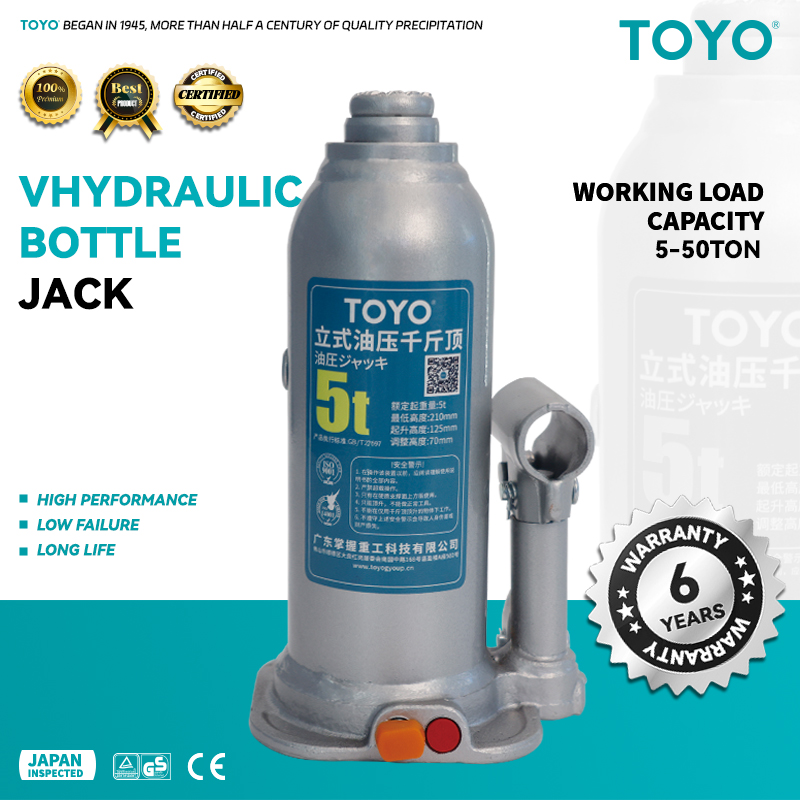
Bottle jacks are compact, vertical cylinders ideal for tight spaces and heavy lifting where portability matters. Floor jacks, on the other hand, feature a low-profile horizontal chassis with wheels, making them perfect for under-vehicle access. The table below summarizes their key differences for UAE users.
| Feature | Bottle Jack | Floor Jack |
|---|---|---|
| Typical Capacity | 2 to 100 tons | 2 to 20 tons |
| Profile Height | Tall, vertical design | Low, horizontal chassis |
| Maneuverability | Portable but requires manual positioning | Easy to roll under vehicles/machinery |
| Best Applications | Construction, heavy equipment maintenance, bridge lifts | Automotive workshops, aviation ground support, light industrial |
| Stability | Narrow base; requires additional support for tall loads | Wide wheelbase offers better stability |
| Price Range (2026) | AED 150 – AED 3,500 | AED 400 – AED 5,000 |
For UAE's construction sector, bottle jacks dominate because of their high tonnage capabilities and compactness for on-site transport. Automotive garages in Al Quoz, however, rely almost exclusively on floor jacks for speed and low clearance access. When choosing, consider not just the lift capacity but also the physical dimensions of your workspace.
Comparing Tonnage Capacities: From 2 Ton to 100 Ton Hydraulic Jacks
The tonnage you need directly correlates with the maximum weight you expect to lift. A 2-ton jack suffices for passenger cars and small equipment, while a 100-ton jack is essential for heavy industrial machinery like turbines, large generators, and structural supports. Over-specifying brings unnecessary cost and weight, but under-specifying is dangerous. As a rule, select a jack rated for at least 25% more than your heaviest load. For example, if you regularly handle 15-ton loads, a 20-ton jack provides a safe buffer.
In the UAE, 10-ton and 20-ton jacks are workhorses in general industry, while 50-ton and 100-ton units are common in oil & gas and marine sectors. Many businesses find that owning a range of jacks—say, a 5-ton, a 20-ton, and a 50-ton—covers most tasks without tying up capital in rarely used equipment.
Manual vs. Electric Hydraulic Jacks: Which Offers Better ROI?
Manual hydraulic jacks are operated by a hand pump, offering simplicity and reliability with zero electricity dependence. Electric hydraulic jacks use a motor-driven pump, enabling faster, effortless lifting—especially beneficial for high-cycle operations. In a UAE manufacturing plant where a team lifts 30 loads per shift, an electric jack can cut cycle time by 60%, justifying its higher upfront cost within months through labor savings. However, for intermittent use, a manual jack's lower purchase price and minimal maintenance make it the smarter choice. Consider total cost of ownership: electric models require periodic motor and cable inspections, while manual jacks need only basic hydraulic upkeep.
Top Features to Look for When Sourcing Hydraulic Jacks in UAE
When evaluating suppliers, prioritize jacks with built-in safety valves that prevent over-extension. Look for heat-resistant seals rated for at least 80°C ambient temperature—standard in UAE summers. A wide, reinforced base and a corrosion-resistant finish (such as zinc-plated rams) combat humidity and salt air in coastal areas like Jebel Ali. Also, ensure the jack comes with a clear, multilingual user manual and local after-sales service. Many international brands lack authorized service centers in the Middle East, leaving you stranded when parts are needed.
What Are the Most Common Mistakes When Purchasing Hydraulic Jacks in UAE?
Even seasoned procurement managers can fall into traps when sourcing lifting equipment. Here are the four most frequent—and costly—errors we see across the Emirates.
Overlooking Certification and Compliance Standards in UAE
UAE authorities, including municipal bodies and free zone regulators, increasingly enforce strict equipment certification. A hydraulic jack without CE, ASME B30.1, or local ESMA (Emirates Authority for Standardization and Metrology) marks can lead to site shutdowns and fines. In 2025, a contracting company in Abu Dhabi faced a AED 50,000 penalty because their imported jacks lacked proper documentation during an OSHAD audit. Always request certificates of conformity and verify that the supplier's products are registered with the relevant UAE bodies. Don't accept photocopies—insist on traceable, verifiable documentation.
Ignoring After-Sales Support and Warranty Terms
Price-focused buyers often overlook warranty coverage and service networks. A jack that fails after six months with no local repair option becomes a paperweight. I recall a client who purchased 20 low-cost bottle jacks from an overseas website. When three failed within the first year, the supplier offered no replacement parts, and shipping them back cost more than the jacks themselves. The lesson: choose suppliers with UAE-based service centers or at least a regional hub in Dubai. A 2-year warranty with on-site support is worth a 15-20% price premium.
Choosing the Wrong Type for Specific Industrial Tasks
Using a bottle jack where a floor jack is needed—or vice versa—creates inefficiency and hazards. I remember a case where a heavy equipment rental company in Mussafah tried to use 20-ton bottle jacks for routine undercarriage inspections on bulldozers. The tall profile made positioning awkward and damaged hydraulic hoses. Switching to low-profile floor jacks eliminated the problem and improved technician safety. Always map the jack's form factor to the task geometry.
Underestimating the Importance of Regular Maintenance
Some buyers treat jacks as "fit-and-forget" tools. Without a maintenance plan, even the best jack will degrade. In the UAE, sand ingestion is the number one killer of hydraulic systems. Budget for replacement seals, fluid, and periodic professional inspections. A maintenance contract with a local supplier often costs less than 10% of the jack's price annually and can double its service life.
How Much Should You Budget for a Hydraulic Jack in UAE in 2026?
Budgeting accurately requires looking beyond the sticker price. Let's break down the real costs of ownership in the current UAE market.
Price Breakdown: Entry-Level vs. Premium Hydraulic Jacks
Entry-level 2-ton bottle jacks start around AED 120, while a premium 100-ton model with advanced safety features can exceed AED 8,000. Floor jacks generally command a 30-50% premium over equivalent bottle jacks due to their more complex chassis. For a typical 20-ton industrial bottle jack, expect to pay between AED 600 and AED 1,800 depending on brand, certifications, and build quality. Chinese-made jacks dominate the lower end, while European and Japanese brands occupy the premium tier with better metallurgy and tighter tolerances.
Hidden Costs: Shipping, Import Duties, and Maintenance in UAE
If you import directly, factor in 5% UAE customs duty on lifting equipment (based on CIF value), plus 5% VAT. Freight costs for heavy jacks can add 15-25% to the purchase price. Then there's the cost of compliance: third-party inspection and certification by a UAE-accredited body typically runs AED 300-800 per jack. Annual maintenance, including fluid changes and seal replacements, averages AED 150-400 per jack for medium-tonnage units. These hidden costs often make local sourcing through established UAE distributors more economical than direct import when total cost is considered.
Calculating ROI: When Does a High-Quality Hydraulic Jack Pay Off?
A premium jack with a 10-year service life and minimal downtime can deliver significantly lower cost per lift than a budget model requiring replacement every 2-3 years. Let's run a simple scenario: a 20-ton jack used 200 times per year. A budget jack at AED 600 lasting 3 years costs AED 1 per lift (excluding maintenance failures). A premium jack at AED 1,800 lasting 10 years costs AED 0.9 per lift, with added reliability and safety. When you factor in avoided accident costs and productivity gains, the premium option almost always wins. For high-utilization environments, the break-even point often arrives within the first 18 months.
Financing and Leasing Options for Heavy Lifting Equipment in UAE
Many UAE-based equipment suppliers and banks offer leasing arrangements for capital-intensive lifting gear. Operating leases allow you to use a 100-ton jack system for a monthly fee, with maintenance included, preserving your cash flow. This can be particularly attractive for project-based businesses in oil & gas or events staging. Check with local financiers like Emirates NBD or specialized equipment leasing firms; some offer Sharia-compliant Ijarah structures. Leasing also ensures you always have access to the latest compliant equipment without obsolescence risk.
What Are the Emerging Trends in Hydraulic Jack Technology for 2026?
The lifting equipment industry is evolving rapidly. Here's what UAE businesses should watch for in 2026.
Smart Hydraulic Jacks with IoT Monitoring Capabilities
Imagine a jack that sends real-time load, pressure, and temperature data to your smartphone. IoT-enabled jacks, equipped with sensors and wireless modules, are entering the market. These systems can alert supervisors to overloading, predict seal failures through pressure trend analysis, and automatically log every lift for compliance reporting. In the UAE's Industry 4.0 push, such smart tools align with digital twin and predictive maintenance strategies being adopted by major players like ADNOC and DP World.
Eco-Friendly Hydraulic Fluids and Sustainable Lifting Solutions
Traditional mineral-based hydraulic fluids pose environmental risks if spilled. Bio-based fluids, derived from vegetable oils, offer high biodegradability and lower toxicity. Several manufacturers now approve these eco-fluids, which also perform well at high temperatures. In environmentally sensitive zones like the Al Wathba Wetland Reserve or offshore islands, switching to green fluids can help meet sustainability targets and avoid cleanup liabilities.
Automation and Robotics in Heavy Lifting: Impact on UAE Industries
Automated lifting systems, integrating hydraulic jacks with robotic positioners, are reducing manual labor in high-risk tasks. For example, in aircraft maintenance hangars at Dubai South, automated jacks synchronized by a central controller can lift an entire A380 for landing gear retraction tests with millimeter precision. While full automation is still capital-intensive, the technology is trickling down to semi-automated systems that use electric pumps and programmable logic controllers for repetitive lifting sequences.
The Shift Towards Lightweight, High-Strength Materials
Advanced alloys and composite materials are making jacks lighter without sacrificing strength. Aluminum alloy jacks, once limited to low tonnages, now reach 20-ton capacities at half the weight of steel equivalents. This trend is a game-changer for mobile service trucks and remote site operations where every kilogram counts. Titanium components are also appearing in premium models, offering corrosion resistance ideal for UAE's coastal and offshore environments.
What Resources Help You Maintain and Inspect Hydraulic Jacks in UAE?
Keeping your jacks in top condition requires the right tools, knowledge, and support network. Here are practical resources available in the region.
Recommended Toolkits for Hydraulic Jack Maintenance
A basic maintenance toolkit should include a seal replacement kit specific to your jack model, a hydraulic pressure gauge, a fluid extraction pump, and a set of soft-face mallets to avoid damaging components during disassembly. Many UAE industrial supply stores, such as those in Deira's Naif market or online via Amazon.ae, offer pre-assembled hydraulic toolkits. For advanced shops, a portable hydraulic test bench allows you to verify jack performance under controlled conditions.
Downloadable Inspection Checklists for UAE Safety Compliance
Several UAE regulatory bodies provide free checklist templates. The OSHAD website offers a "Lifting Equipment Inspection Checklist" aligned with Abu Dhabi's code of practice. Dubai Municipality's Building Department also publishes guidelines for lifting gear on construction sites. You can download these PDFs, translate key sections for multilingual teams, and laminate them for daily use. A typical checklist covers ID label, leaks, ram condition, base integrity, and operational test results.
Training Programs and Certifications for Lifting Equipment Operators
Competent operator training is a legal requirement in the UAE. Organizations like the Emirates Institute for Health & Safety (EIHS) and TUV Middle East offer certified courses on hydraulic jack safety and rigging. These 1-2 day programs cover theory, hands-on practice, and assessment. Upon completion, operators receive a card valid for 2-3 years. Investing in training not only reduces accident risk but also demonstrates due diligence during regulatory audits.
Where to Find Reliable Hydraulic Jack Suppliers and Service Centers in UAE
The UAE hosts a robust network of lifting equipment specialists. In Dubai, the Ras Al Khor industrial area and Al Quoz are hubs for suppliers stocking everything from a 2-ton hand pallet jack to 100-ton hydraulic cylinders. When evaluating a supplier, check for ISO 9001 certification, a physical showroom, and a dedicated service team. Many reputable firms offer annual maintenance contracts (AMCs) that include on-site inspections, emergency repairs, and compliance documentation. Don't hesitate to ask for client references in your industry—reliable suppliers will gladly provide them.
As you integrate these practices into your operations, remember that safety and efficiency go hand in hand. Whether you're lifting a transformer in a Musaffah yard or maintaining a fleet of trucks in Al Quoz, the right hydraulic jack and the right knowledge make all the difference. Ready to upgrade your lifting setup or need expert advice on compliance? Reach out to a trusted UAE-based supplier today and request a demo of the latest jack technologies. Your crew's safety and your bottom line will thank you.
References
- OSHA Standard 1910.244 – Jacks
- ASME B30.1 – Jacks, Industrial Rollers, and Hand Carts
- OSHAD Code of Practice for Lifting Equipment (UAE)
- ISO 45001:2018 Occupational Health and Safety Management Systems
- Grand View Research – Hydraulic Jacks Market Size & Share Report, 2025-2030
- MarketsandMarkets – Hydraulic Cylinder Market Forecast to 2028