When purchasing an electric hoist, selecting the right lifting capacity is only part of the decision. The power supply is another critical factor that affects equipment compatibility, installation requirements, and daily operation.
For industrial buyers, distributors, and equipment procurement professionals, one common question is: What is the difference between a single-phase and a three-phase electric hoist?
Both power configurations are used in electric lifting equipment, but they are designed for different electrical environments and operating requirements. Choosing the wrong configuration can lead to installation problems, additional electrical work, or incompatibility with the available power supply.
In this guide, we explain the key differences between single-phase and three-phase electric hoists, what buyers should consider before ordering, and how to identify the appropriate configuration for your application.
1. What Is a Single-Phase Electric Hoist?
A single-phase electric hoist operates using a single-phase AC power supply. This type of electrical supply is commonly found in smaller facilities, workshops, and locations where three-phase power may not be available.
Depending on the model and its rated specifications, a single-phase electric hoist can be suitable for light-duty lifting tasks, equipment installation, maintenance work, and certain workshop applications.
However, not every single-phase hoist is suitable for every lifting task. Buyers must check the rated lifting capacity, motor specifications, duty classification, lifting speed, and operating conditions before selecting a model.
Common Applications
Single-phase electric hoists may be considered for:
-
Small workshops and maintenance facilities
-
Equipment installation and repair
-
Light industrial lifting operations
-
Locations with an appropriate single-phase power supply
-
Applications where the selected hoist’s rated capacity and duty rating meet the requirements
The suitability of a single-phase hoist depends on the specific product design and application rather than the power supply alone.
2. What Is a Three-Phase Electric Hoist?
A three-phase electric hoist operates using a three-phase AC power supply. This configuration is widely used in industrial facilities, manufacturing plants, warehouses, and other environments equipped with three-phase electrical infrastructure.
Three-phase power is commonly used for industrial motor-driven equipment. Depending on the motor design and hoist specifications, it can support a range of lifting capacities, operating frequencies, and duty requirements.
For buyers sourcing equipment for continuous production processes or demanding industrial applications, three-phase models may be appropriate when the electrical infrastructure and equipment specifications are compatible.
Common Applications
Three-phase electric hoists may be considered for:
-
Manufacturing and assembly lines
-
Industrial warehouses and distribution facilities
-
Machinery installation and maintenance
-
Production workshops
-
Applications requiring higher operating frequency or specific industrial duty ratings
The actual performance of an electric hoist depends on its engineering design, motor rating, gearbox, braking system, and duty classification. A three-phase power supply alone does not guarantee greater lifting capacity or longer service life.
3. Single-Phase vs. Three-Phase Electric Hoists: Key Differences
The following table summarizes the main considerations when comparing the two configurations.
| Comparison Factor | Single-Phase Electric Hoist | Three-Phase Electric Hoist |
|---|---|---|
| Power supply | Single-phase AC | Three-phase AC |
| Electrical infrastructure | Requires a compatible single-phase supply | Requires a compatible three-phase supply |
| Typical application | Selected workshops and light industrial tasks | Manufacturing plants and industrial facilities |
| Motor configuration | Depends on the specific model | Depends on the specific model |
| Lifting capacity | Determined by the rated specifications | Determined by the rated specifications |
| Operating frequency | Must match the equipment’s duty rating | Must match the equipment’s duty rating |
| Installation | Requires a compatible electrical circuit | Requires a compatible three-phase circuit |
| Purchasing considerations | Confirm voltage, frequency, capacity, and duty rating | Confirm phase, voltage, frequency, capacity, and duty rating |
Important: These are general selection guidelines, not universal technical rules. Both power configurations must be evaluated against the manufacturer’s specifications and the intended working conditions.
4. Five Factors to Check Before Purchasing an Electric Hoist
Selecting the correct power configuration requires more than confirming whether a facility has single-phase or three-phase electricity.
Before placing an order, buyers should review the following five factors.
4.1 Confirm the Available Power Supply
Start by checking the electrical infrastructure at the installation site.
Confirm:
-
Whether single-phase or three-phase power is available
-
The required operating voltage
-
The local power frequency
-
The electrical supply capacity
-
Any applicable electrical installation requirements
Voltage and frequency vary across countries and regions. A hoist designed for one electrical configuration may not be suitable for another without an explicitly approved configuration.
For international buyers, confirming these details before ordering can help avoid compatibility issues after delivery.
4.2 Match the Hoist to the Required Lifting Capacity
The rated lifting capacity must meet the requirements of the intended application.
Buyers should identify the maximum load to be lifted and select equipment with an appropriate rated capacity. The load must never exceed the hoist’s rated capacity.
It is also important to consider the weight of lifting attachments, the configuration of the lifting system, and any applicable requirements for the installation.
For example, a workshop handling relatively light components may have different equipment requirements from a manufacturing facility lifting heavy machinery throughout a production shift.
Do not select a hoist based solely on its power supply or motor rating. The complete equipment specifications must be evaluated.
4.3 Consider the Duty Rating and Operating Frequency
How frequently will the hoist operate?
A hoist used occasionally for equipment maintenance may have different duty requirements from a hoist used repeatedly throughout a manufacturing shift.
Before purchasing, review the manufacturer’s specified duty classification, operating cycle, permissible starts per hour, and other applicable operating limitations.
Selecting equipment with an appropriate duty rating helps ensure that the hoist is suitable for its intended workload.
A three-phase hoist is not automatically suitable for heavy-duty operation. Its actual duty rating must be confirmed from the technical documentation.
4.4 Check Lifting Speed and Control Requirements
Lifting speed can affect workflow efficiency, positioning accuracy, and overall equipment suitability.
Some applications require straightforward lifting and lowering, while others may benefit from more precise load positioning or variable-speed control.
Buyers should confirm:
-
Rated lifting speed
-
Single-speed or dual-speed operation
-
Control voltage and pendant configuration
-
Emergency stop requirements
-
Compatibility with the intended lifting system
These features depend on the selected model and should be verified before an order is finalized.
4.5 Verify Installation Space and Mounting Configuration
Electrical compatibility is only one part of installation planning.
The hoist must also fit the available space and work with the intended support structure.
Check the required lifting height, available headroom, mounting arrangement, trolley compatibility, and beam specifications where applicable.
If the hoist will be installed on a crane or beam-mounted system, confirm that the complete installation is suitable for the intended load and operating conditions.
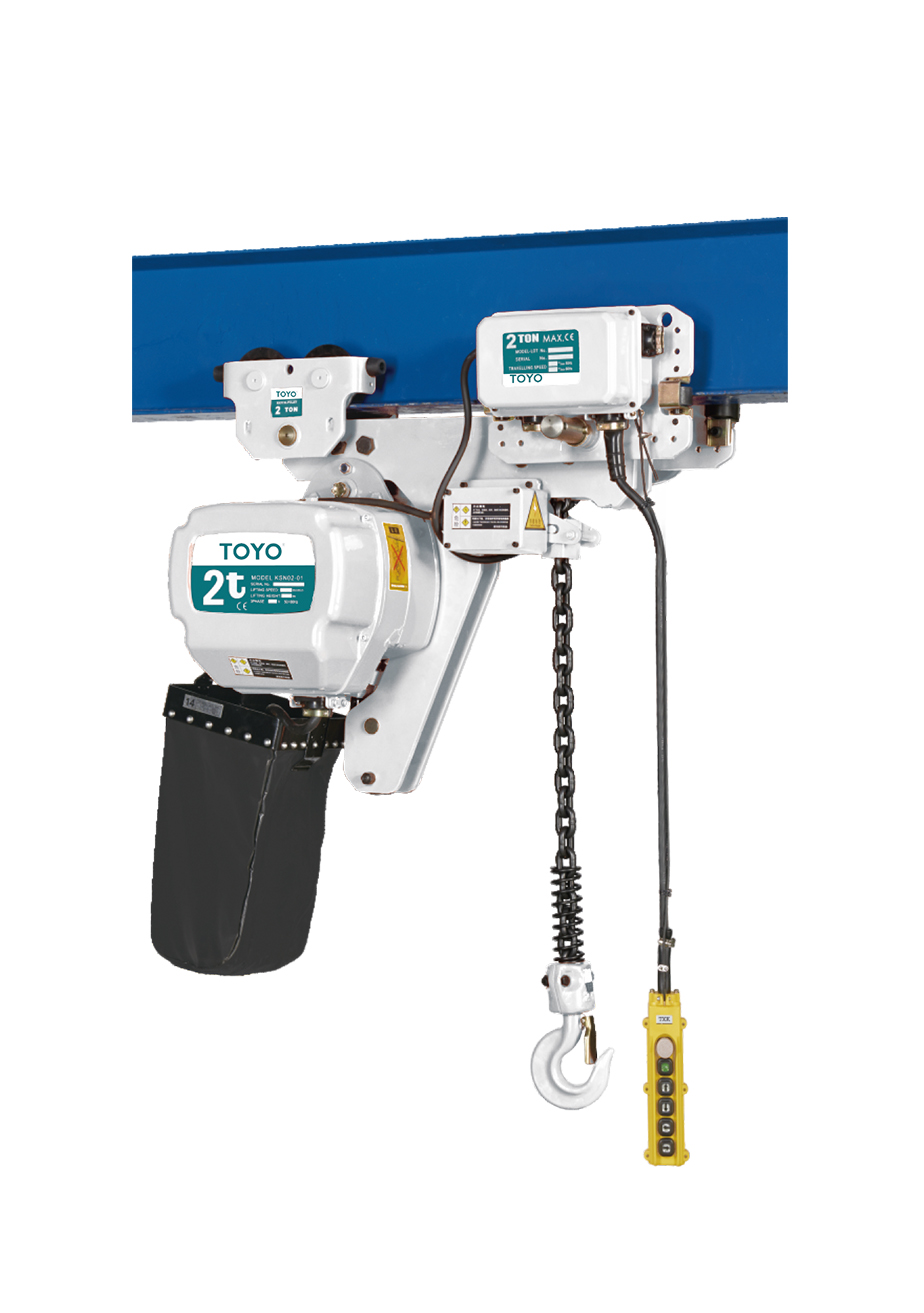
For applications with limited headroom, buyers can also review TOYO’s low-headroom electric chain hoist for a product configuration designed for space-constrained lifting applications.
5. What Should Importers and Distributors Confirm with a Manufacturer?
For international buyers, choosing an electric hoist involves more than comparing product prices.
Before placing a bulk order, importers and distributors should confirm the following information with the manufacturer.
Electrical specifications
Request the rated voltage, phase, frequency, motor power, and applicable electrical documentation for the exact model being considered.
Product configuration
Confirm the lifting capacity, lifting height, lifting speed, mounting type, control arrangement, and other required options.
Quality assurance
Ask about manufacturing inspections, product testing, quality control procedures, and the documentation available for the selected model.
Order requirements
Confirm the minimum order quantity, production lead time, packaging specifications, and shipping arrangements.
Customization options
If the equipment is intended for distribution under a private label, discuss the available branding, packaging, and product customization options before production.
Technical support
Clarify the availability of operating manuals, spare parts, warranty terms, and after-sales assistance.
TOYO provides information about its quality assurance procedures and product testing services. Buyers should confirm the specific documentation and services available for their selected model.
6. Explore TOYO Electric Chain Hoists
TOYO offers electric chain hoist solutions for a range of industrial lifting applications.
When evaluating a suitable model, buyers should consider the complete equipment configuration rather than selecting a product based on lifting capacity alone.
Relevant factors include:
-
Rated lifting capacity
-
Available power supply configuration
-
Lifting height and speed
-
Fixed or trolley-mounted installation
-
Duty rating and working environment
-
Required control functions and accessories
You can explore the TOYO electric chain hoist product range to review available equipment options.
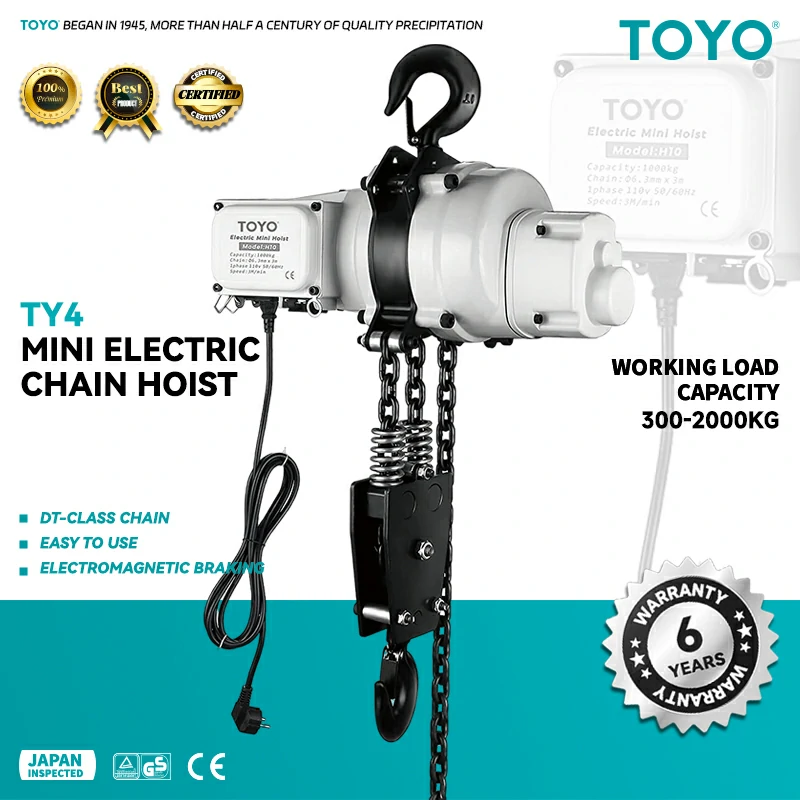
For buyers evaluating specific configurations, the TOYO TY1 fixed-type electric chain hoist is another product page to review.
Always confirm the available voltage, phase, frequency, rated capacity, and other technical specifications with TOYO before ordering. Product configurations may vary by model and market requirements.
7. Frequently Asked Questions
Is a three-phase electric hoist always better than a single-phase model?
No. The appropriate configuration depends on the available power supply, the intended application, and the manufacturer’s specifications.
A single-phase model may be suitable for certain workshop applications, while a three-phase model may be more appropriate for an industrial facility with compatible electrical infrastructure.
Neither configuration is universally better for every application.
Can a single-phase electric hoist be connected to a three-phase power supply?
Not directly unless the equipment is explicitly designed and approved for that connection. The power supply must match the hoist’s specified electrical configuration.
Using an incompatible supply can damage equipment and create serious electrical hazards. Consult the manufacturer or a qualified electrician before installation.
Can a three-phase electric hoist operate on single-phase power?
A standard three-phase hoist should not be connected directly to a single-phase supply unless the manufacturer has approved a suitable solution for that specific model.
Any approved power conversion arrangement must be compatible with the motor, controls, braking system, and other electrical components. Obtain written technical confirmation before proceeding.
Does three-phase power mean the hoist can lift heavier loads?
Not necessarily. Rated lifting capacity is determined by the equipment’s mechanical design, motor and transmission specifications, braking system, and other engineering factors.
Always use the manufacturer’s rated capacity and technical documentation when selecting lifting equipment.
What information should I provide when requesting a quotation?
To help a manufacturer recommend a suitable configuration, provide:
-
Required lifting capacity
-
Required lifting height
-
Available voltage, phase, and frequency
-
Expected operating frequency and duty requirements
-
Fixed or trolley-mounted configuration
-
Intended application and working environment
-
Destination country and any applicable compliance requirements
Providing this information at the beginning of the inquiry can help the supplier evaluate your requirements more accurately.
Conclusion
Choosing between a single-phase and a three-phase electric hoist starts with understanding the electrical infrastructure and the requirements of the intended lifting application.
Single-phase models may be suitable for selected workshops and light industrial tasks, while three-phase models are commonly considered for industrial facilities with compatible power supplies. However, neither configuration should be selected without reviewing the equipment’s complete technical specifications.
Before placing an order, confirm the power supply, rated lifting capacity, duty rating, lifting speed, mounting configuration, and applicable safety requirements.
If you are sourcing electric chain hoists for your factory, distribution business, or industrial project, TOYO can help you review the available product options against your requirements.
Contact TOYO Industry to discuss your application and request product information or a quotation.